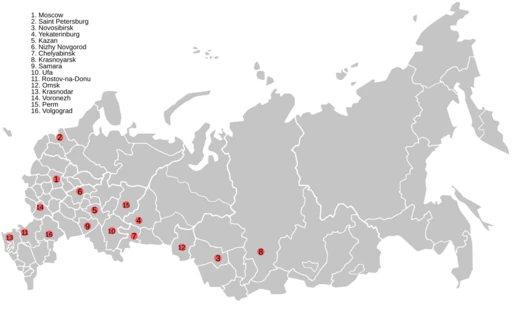
Yekaterinburg
Russian industrial and cultural centre, fourth most populous city.
Yekaterinburg—also spelled Ekaterinburg, and called Sverdlovsk between 1924 and 1991—is the administrative hub of Sverdlovsk Oblast and the Ural Federal District in Russia. It sits on the Iset River, straddling the area between the Volga-Ural region and Siberia. The city proper holds about 1.5 million people, with its wider urban agglomeration reaching up to 2.2 million. It ranks as Russia’s fourth most populous city, the largest in the Ural Federal District, and a major cultural and industrial center. Often called the “third capital of Russia,” it stands behind only Moscow and Saint Petersburg in economic size, culture, transport, and tourism.
The city was founded on 18 November 1723 and took its name from the Orthodox name of Catherine I, the wife of Emperor Peter the Great. It began as the mining capital of the Russian Empire and served as a strategic link between Europe and Asia. In 1781, Catherine the Great made it a district town of Perm Province and routed the historic Siberian Road through it, turning Yekaterinburg into a key city for resource-rich Siberia. By the late 1800s, it had become a center for revolutionary movements in the Urals. During the Russian Civil War, it was the site where the Romanov family was killed. In 1924, after the Russian SFSR founded the Soviet Union, the city was renamed Sverdlovsk after Bolshevik leader Yakov Sverdlov. Under Soviet rule, a tram network was finished in 1929, and the city and its surroundings were transformed into a heavy-industry powerhouse. The Sverdlovsk Metro opened in April 1991, and that September the city reclaimed its original name.
Today, Yekaterinburg is one of Russia’s most important economic centers and hosted matches during the 2018 FIFA World Cup. The 21st century brought economic and population growth, leading to some of Russia’s tallest skyscrapers rising here. The city houses the headquarters of the Central Military District of the Russian Armed Forces and the presidium of the Ural Branch of the Russian Academy of Sciences. It is known for its constructivist architecture and is often called the “Russian capital of street art.”
**History**
**Prehistory**
People settled the area long ago. The earliest known settlements date to 8000–7000 BC, during the Mesolithic period. At the Isetskoe Pravoberezhnoye I site, a Neolithic settlement from 6000–5000 BC has been found, featuring stone-proces
- Founded
- 18 November 1723
- Founders
- Vasily Tatishchev and Georg Wilhelm de Gennin
- Named after
- Catherine I (wife of Peter the Great)
- Former name
- Sverdlovsk (1924–1991)
- Population
- Roughly 1.5 million residents (up to 2.2 million in urban agglomeration)
- Region
- Sverdlovsk Oblast, Ural Federal District, Russia
- Known for
- Mining capital of the Russian Empire; site of the murder of the Romanov family; host city of the 2018 FIFA World Cup
Lore & Background
Yekaterinburg served as the mining capital of the Russian Empire and a strategic connection between Europe and Asia. In 1781, Catherine the Great gave it the status of a district town of Perm Province and built the historical Siberian Route through the city. In the late 19th century, it became a centre of revolutionary movements in the Urals. During the Russian Civil War, it was the site of the murder of the Romanov family. In 1924, it was renamed Sverdlovsk after Bolshevik leader Yakov Sverdlov. During the Soviet era, a tram network was completed in 1929, and the city became a heavy industry powerhouse. The Sverdlovsk Metro opened in April 1991, and in September 1991 the city returned to its historical name.
Reader's Guide
Yekaterinburg is one of Russia's most important economic centres and was one of the host cities of the 2018 FIFA World Cup. In the 21st century, it has experienced an economic and population boom, resulting in some of the tallest skyscrapers in Russia being located there. The city is home to the headquarters of the Central Military District of the Russian Armed Forces and the presidium of the Ural Branch of the Russian Academy of Sciences. It is famous for its constructivist architecture and is considered the 'Russian capital of street art'. Its historical significance includes being the mining capital of the Russian Empire, a key city to Siberia, and the site of the Romanov family's murder. The city's founding by Tatishchev and de Gennin under Peter the Great established it as a major industrial centre, a role it continues to play today.
Did You Know?
- Yekaterinburg was founded on 18 November 1723 and named after Catherine I, wife of Peter the Great.
- The city was renamed Sverdlovsk from 1924 to 1991 after Bolshevik leader Yakov Sverdlov.
- During the Russian Civil War, Yekaterinburg was the site of the murder of the Romanov family.
- Yekaterinburg is considered the 'Russian capital of street art' and is famous for its constructivist architecture.
More in Russian Cities 1-17
Spotted an error? Know more?
This is a living reference — every entry is fact-audited, and reader corrections feed straight into our audit queue. Suggest an edit · See this site's audit record