Yaroslavl
Historic Russian city at the Volga-Kotorosl confluence.
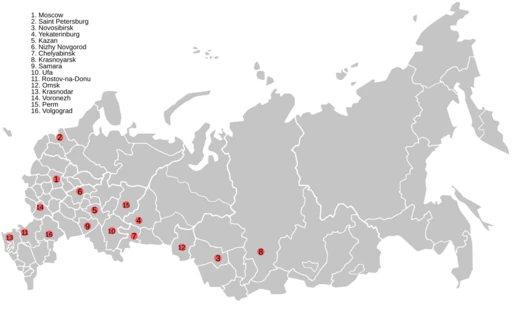
Yaroslavl is a city in western Russia, serving as the administrative center of Yaroslavl Oblast. It lies about 250 kilometers northeast of Moscow. The city’s historic district, situated where the Volga and Kotorosl rivers meet, is a UNESCO World Heritage Site. Yaroslavl also belongs to the Golden Ring, a collection of historically significant towns northeast of Moscow. According to the 2021 census, its population was 577,279.
The area’s earliest known settlement dates back to the 5th–3rd millennium BCE, on the Volga’s left bank opposite the Strelka—the cape at the rivers’ confluence. In the 9th century, a large Scandinavian-Slavic settlement called Timerevo emerged nearby, part of the Rus’ Khaganate. Excavations there uncovered burial mounds, Scandinavian weapons with runic writing, chess pieces, and northern Europe’s largest hoard of Arabian coins, the oldest minted under the first Idrisid. Archaeologists also found the fourth set of Scandinavian brooches ever discovered in Russia. This proto-Yaroslavl likely served as a major hub on the Volga trade route, but it declined soon after Yaroslavl was founded, probably because the route fell out of use. Upstream, outside the modern city, a large necropolis with mostly Finno-Ugric-style graves has been studied.
Yaroslavl itself is the oldest existing town on the Volga. It was founded by Yaroslav the Wise, a prince of Kievan Rus’, while he ruled the Principality of Rostov (988–1010). According to tradition, he first came ashore at the Strelka, now a park. Protected by the steep banks of the Volga, Kotorosl, and Medveditsa rivers, Yaroslav and his men built the first Yaroslavl Kremlin there. The city’s first recorded event was the Rostov Uprising of 1071, triggered by famine. Its name traditionally links to its founder.
By the 12th century, the Petropavlovsky and Spaso-Preobrazhensky monasteries had been established beyond the city limits, later absorbed as the city grew. For its first two centuries, Yaroslavl was a minor fortified town in the Rostov-Suzdal lands. In the early 13th century, Prince Konstantin made it one of his main residences. Before his death in 1218, he divided his lands among his sons, giving Yaroslavl to his second son, Vsevolod. This created the independent Principality of Yaroslavl, which included northern territories and lasted until 1463, when it was absorbed into the Principality of Mos
- Founded
- c. 988–1010 by Yaroslav the Wise
- Population (2021 census)
- 577279
- First recorded event
- Rostov Uprising of 1071
- Principality capital
- From 1218
- Incorporated into Moscow
- 1463 (de jure 1471)
- World Heritage Site
- Historic part of the city
Lore & Background
The oldest settlement in the area dates from the 5th–3rd millennium BCE on the left bank of the Volga. In the 9th century, a large Scandinavian-Slavic settlement existed at Timerevo near Yaroslavl, known for burial mounds, Scandinavian weapons with runic inscriptions, chess pieces, and the largest collection of Arabian coins in northern Europe. This 'proto-Yaroslavl' was a major center for the Volga trade route but declined soon after the founding of Yaroslavl, probably due to the route's termination.
Yaroslavl was founded by Yaroslav the Wise during his rule of the Principality of Rostov (988–1010) when he stepped ashore at the Strelka. The first recorded event was the Rostov Uprising of 1071, caused by famine. By the 12th century, the Petropavlovsky and Spaso-Preobrazhensky monasteries had been developed. From the early 13th century, Yaroslavl was ruled by Konstantin and became one of his primary residences; upon his death in 1218, the land passed to his son Vsevolod, forming the independent Principality of Yaroslavl.
The city suffered frequent fires due to wooden construction, including a devastating fire in 1221. Mongol invasions struck in 1257 (under Möngke Khan), 1293, and 1322, and plague hit in 1278 and 1364. A mass grave of at least 300 bodies from a 1238 Mongol invasion was discovered in 2005. In 1463, the principality was absorbed into the Grand Duchy of Moscow. In the 16th century, stone construction replaced wood, and the Spaso-Preobrazhensky monastery was rebuilt in 1506–1516, becoming the oldest unchanged building in the city. Economic prosperity from Volga trade with Arkhangelsk attracted English and German merchants, but the Time of Troubles (c. 1598–1613) brought famine and plundering by Polish-Lithuanian forces.
Reader's Guide
Yaroslavl holds a significant place in Russian history as one of the oldest existing towns on the Volga and a key center during the medieval period. Its foundation by Yaroslav the Wise links it to the early Kievan Rus' state, and its role as capital of an independent principality from 1218 until absorption into Moscow in 1463 illustrates the political fragmentation and consolidation of Russian lands. The city's prominence in the 17th century as Russia's second-largest city and de facto capital during the Polish occupation of Moscow underscores its strategic and political importance. Today, Yaroslavl is an important industrial center, with petrochemical, tire, and diesel engine plants, and its location at the confluence of major rivers facilitated transportation and power development. The historic part of the city is a UNESCO World Heritage Site, preserving architectural monuments such as the Spaso-Preobrazhensky Monastery. The archaeological discoveries at Timerevo, including Scandinavian artifacts and Arabian coins, highlight Yaroslavl's early role in the Volga trade route and its connections to both Scandinavian and Islamic worlds. The city's legacy is also marked by repeated destruction from fires, Mongol invasions, and plague, requiring multiple reconstructions that shaped its current stone-built character.
Did You Know?
- The oldest settlement in Yaroslavl dates from the 5th–3rd millennium BCE.
- The largest collection of Arabian coins in northern Europe was found at the Timerevo settlement near Yaroslavl.
- Yaroslavl was Russia's second-largest city in the 17th century and served as the de facto capital during the Polish occupation of Moscow in 1612.
- A mass grave containing at least 300 bodies from a Mongol invasion in 1238 was discovered in Yaroslavl in 2005.
More in Russian Cities 1-17
Spotted an error? Know more?
This is a living reference — every entry is fact-audited, and reader corrections feed straight into our audit queue. Suggest an edit · See this site's audit record