Voronezh
Russian city founded as a fort, later a key shipbuilding center.
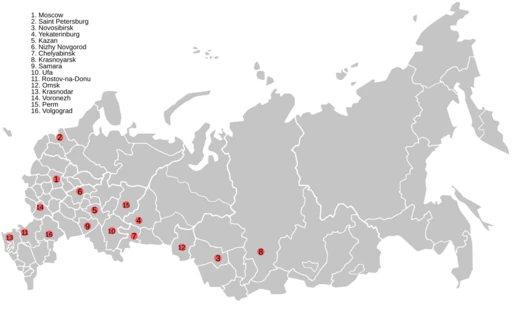
Voronezh is a city and the administrative centre of Voronezh Oblast in southwestern Russia, straddling the Voronezh River near its confluence with the Don River. It was established in 1586 as a fort to protect trade routes from slave raids, and later became a major shipbuilding center under Peter the Great, playing a key role in the Azov campaigns. The city experienced rapid population growth, reaching 1,057,681 by the 2021 Census, making it the 14th-most populous city in Russia.
- Founded
- 1586
- Founder
- Feodor I
- Population (2021 Census)
- 1,057,681
- Location
- Southwestern Russia, on the Voronezh River
- Historical Role
- Fortress, shipbuilding center, administrative seat
- Notable Event
- Site of fierce fighting during World War II
Lore & Background
The first chronicle references to the word Voronezh date to 1177, when Prince Yaropolk of Ryazan fled 'to Voronozh.' Modern archaeology reveals a Slavic town-planning complex from the 8th to early 11th century covering about 42 km with 13 forts. The name's origin is disputed: Soviet historian Vladimir Zagorovsky proposed it derived from a hypothetical Slavic personal name Voroneg, but this is now criticized. A 2015–2016 analysis by historian Pavel Popov suggests Voronezh is a Slavic macrotoponym meaning 'black, dark,' referring to black forests. Folk etymology linking it to 'raven' and 'hedgehog' lacks scientific support.
Reader's Guide
Voronezh's significance lies in its role as a frontier fortress and later as the birthplace of the Russian navy under Peter the Great, whose Azov Flotilla was built there in the 1690s. During World War II, the city was a key battleground, with 92% of buildings destroyed. Its post-war reconstruction and industrial growth, including aviation and heavy machinery, marked its recovery. The city's rapid population increase in the 21st century underscores its ongoing regional importance. The disputed etymology of its name reflects layers of Slavic and medieval history, while the 1989 UFO claims highlight a curious modern episode.
Did You Know?
- The first Russian ship of the line, Goto Predestinatsia, was built in Voronezh.
- In 1941, Voronezh was one of only three Soviet cities to hold a troop parade on the anniversary of the October Revolution.
- A 2015–2016 analysis concluded the name Voronezh likely derives from a Slavic root meaning 'black, dark,' referring to forests.
- In 1989, TASS published details of an alleged UFO landing in a city park, though a cited scientist later said he was misquoted.
Frequently Asked Questions
Who is Voronezh?
Voronezh is the administrative capital of Voronezh Oblast, sitting in southwestern Russia at the point where the Voronezh River flows into the Don. It functions as the political and economic backbone of that entire region.
How did Voronezh first enter the story?
The city's origin goes back to 1586, when Tsar Feodor I ordered a defensive fort to be raised along the river to shield overland trade corridors from Tatar slave raids. That single military outpost gradually expanded into one of Russia's most significant urban settlements.
What is Voronezh's signature role or 'power'?
Its defining contribution to the national narrative is naval shipbuilding; under Peter the Great the city became a critical yard that powered the Azov campaigns. It has also long served as the administrative and industrial heart of its oblast.
How large is Voronezh by the end of the timeline?
The 2021 Census recorded roughly 1.06 million residents, making it the fourteenth-largest urban settlement in the country.
What is the most dramatic moment in Voronezh's arc?
The city endured some of the heaviest urban combat of the Second World War, with its streets turning into a brutal and prolonged battleground. Surviving that siege cemented its reputation as a place that refuses to be erased from the map.
More in Russian Cities 1-17
Spotted an error? Know more?
This is a living reference — every entry is fact-audited, and reader corrections feed straight into our audit queue. Suggest an edit · See this site's audit record