Frequently Asked Questions
The most-asked questions about russian cities.
What exactly is this encyclopedia about?
It is a fan-curated reference that treats Russian cities as distinct cultural 'characters,' cataloguing their histories, personalities, architectural identities, and how they relate to one another. Think of it as a living wiki where every settlement gets a profile page.
Who are the main characters in the cast?
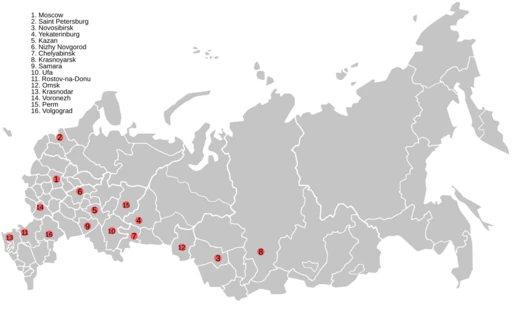
Moscow and St. Petersburg anchor most entries as the political and artistic poles, but cities like Kazan, Novosibirsk, Yekaterinburg, and Vladivostok carry equally rich backstories and devoted followings. The 'ensemble' extends to smaller towns with strong local identities.
Where should a newcomer begin reading?
Start with Moscow for the densest concentration of history and current events, then move to St. Petersburg for the imperial and artistic thread. After that, pick a regional city that matches your interests—industrial, riverine, or frontier.
How large is the overall cast?
Russia officially counts more than 1,100 cities and urban-type settlements, though most fan pages focus on the roughly 30 largest by population. The long tail of smaller towns is where the most niche, community-driven entries live.
What is the 'setting' these characters inhabit?
The cities stretch across 11 time zones, from the Baltic coast to the Pacific, and span climates from humid subtropical in Sochi to subarctic in Murmansk. Geography is a defining trait: river cities, port cities, and landlocked industrial hubs each get their own sub-lore.
How are the cities grouped into 'factions'?
The most common organizing principle is the federal district—Central, Northwestern, Volga, Ural, Siberian, Far Eastern, and so on. Fans also cluster cities by function, such as transport hubs, university towns, or former industrial centers.
What are the most cited 'origin stories'?
Moscow's traditional founding is pinned to 1147, while St. Petersburg was laid out by Peter the Great in 1703 as a deliberate gateway to Western Europe. Siberian cities like Tobolsk and Krasnoyarsk trace their roots to 16th-century fur-trade outposts.
What do fans argue about the most?
The perennial debate is whether St. Petersburg or Moscow holds the 'true' cultural capital role, and how much weight to give Siberian and Far Eastern cities versus the European core. Soviet-era urban planning—panel blocks, planned microdistricts—is another constant flashpoint.
What counts as 'canon' versus 'fanon' here?
Canon means verifiable data: census figures, official city-designation dates, government records, and peer-reviewed history. Fanon covers popular nicknames, travel-blogger myths, internet memes, and the kind of lore that spreads through forums but never appears in a textbook.
How do the characters interact with one another?
Rail corridors, river routes, air links, and centuries of migration weave the cities into a single urban ecosystem. Economic specialization—steel in Magnitogorsk, shipping in Novorossiysk, tech in Yekaterinburg—creates the trade and cultural exchanges that form the 'relationships' fans track.